Beginner boxing footwork starts with short steps and a stance you can recover to. Practise moving forward, backward and sideways before adding punches or speed. The five drills below build a clear sequence: establish your base, change distance, move laterally, pivot, then exit after a combination.
You do not need an agility ladder or a gym-sized ring. Clear a non-slip area with enough room to step without hitting furniture. Use comfortable footwear and work at a controlled pace. A coach can help choose a stance width that fits you.
Before the drills: find your starting stance
Stand with your lead foot forward and your rear foot offset behind it. Keep your knees relaxed and your hands in guard. Orthodox and southpaw boxers use the same lead/rear instructions, with opposite feet leading.
Take a small step and pause. You should be able to move again without first uncrossing your legs or gathering your feet together. If the stance feels rigid, shorten the step and reset. The boxing technique guide covers the stance and guard baseline.
These drills use basic step-and-slide movement. More advanced steps exist, but a beginner needs a reliable base before experimenting with stance switches or crossing footwork.
Drill 1: stance reset
Start in your boxing stance. Take a short step forward, restore the stance and pause. Return to your starting spot using a small backward step and another reset. Keep your hands organized throughout.
What to check: your feet remain separated and your weight does not fall so far forward that you need an extra recovery step. Use floor markers if they help you see how far your feet drift.
Common mistake: trying to stay permanently high on your toes. Aim for a stable, mobile base rather than a tense posture you cannot maintain.
Drill 2: forward and backward step-and-slide
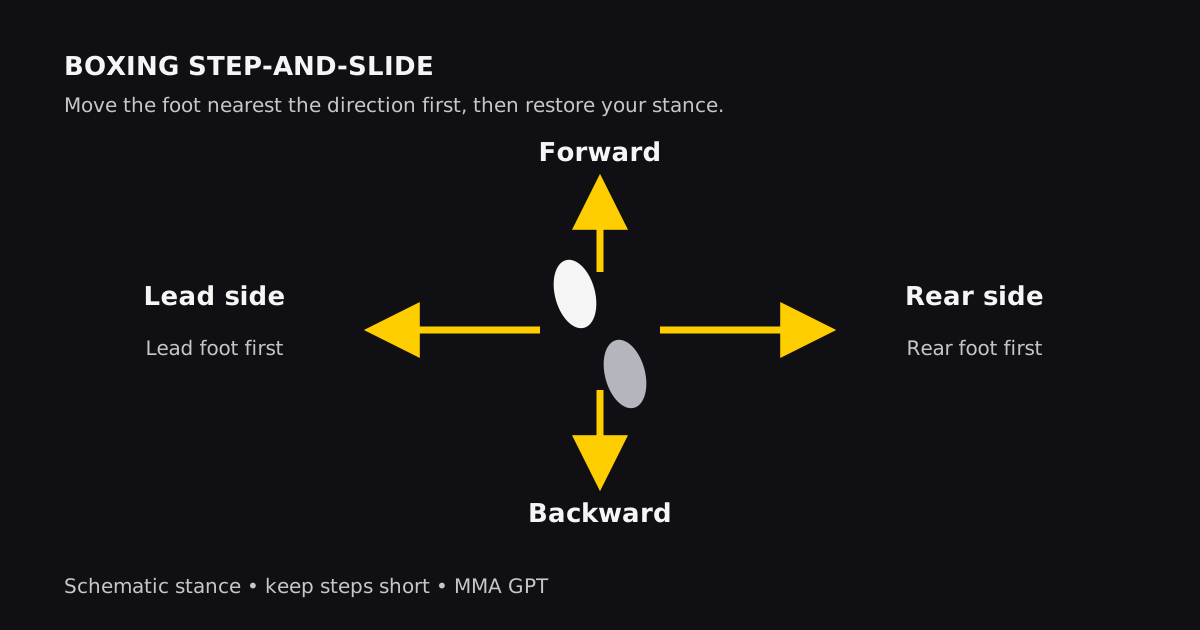
For a basic forward step, move the lead foot first and bring the rear foot along. For a backward step, move the rear foot first and let the lead foot follow. Use short steps and recover your stance after each movement.
Practise several steps in one direction, pause, then reverse. Add a light jab only after the footwork is stable and your coach has checked the timing.
What to check: neither foot drags so far that the stance widens excessively. The follow-up step restores your base rather than bringing your feet together.
Drill 3: lateral steps
Move the foot nearest the direction first. Step toward your lead side with the lead foot, then bring the rear foot along. Toward your rear side, move the rear foot first, then the lead foot.
Keep the distance small enough to stay balanced. Practise two steps one way, pause and return. You should remain ready to throw or defend after the reset.
What to check: no crossed feet in this basic drill and no bouncing your feet together between directions. Speed comes after the movement is repeatable.
Drill 4: controlled pivot
Begin with a small pivot your coach has taught. Let your feet turn without forcing a twist through a planted knee. Pause in the new stance and check that your hands remain near guard.
Start with a modest angle rather than trying to spin through a large turn. A good practice rep finishes with balance, not merely with your body facing a different direction.
What to check: your stance is still separated after the turn and you can take another step without stumbling. Have your coach check the pivot before combining it with fast punches.
Drill 5: combination, reset and exit
Throw a light jab-cross, return your hands and take one small step away or to the side. Reset before repeating. Choose a direction you already practised in drills two and three.
Once the sequence is comfortable, try the same movement after a jab-cross-lead hook. The boxing combinations guide explains the punch numbers and progressions.
What to check: your final punch does not leave you leaning or square. The exit is part of the repetition, not a hurried movement after your balance is already gone.
A seven-minute footwork routine
Use the boxing round timer with five one-minute rounds and 30 seconds of rest between them. That is five minutes of work and four half-minute rests: seven minutes before warm-up and cool-down.
| Round | Drill | Focus |
|---|
| 1 | Stance reset | A repeatable starting position |
| 2 | Forward and backward steps | Distance without reaching |
| 3 | Lateral steps | Feet stay separated |
| 4 | Small pivots | A stable finish |
| 5 | Combination and exit | Guard and balance after punching |
Repeat the block only if you can keep the same control. If you get tangled when changing direction, reduce speed and practise one direction at a time. A shorter clean round gives you more useful practice than a longer round of repeated mistakes.
Film your footwork for review
Set the phone far enough back to include your feet and hands. Keep the floor and the direction of movement visible. Film a short clip at a controlled pace, rather than selecting only your fastest repetitions.
Watch for feet coming together, an excessively wide stance, crossed steps in the basic drill, leaning after punches and a dropped guard during the exit. Pick one issue to discuss with your trainer.
The AI boxing coach can review a clip and link a correction to a timestamp. Replay the moment and check that the feedback matches the visible action. Repeat the same drill after practice to see whether the movement has changed.
Use the boxing training app for the complete feedback loop. For solo striking rounds, the shadow boxing app explains how to record useful footage. Your first analysis is free, no card needed.
Frequently asked questions
Can I practise boxing footwork without equipment?
Yes. Use a clear non-slip space for short forward, backward and lateral steps, then add a controlled pivot. Tape markers can help but are optional.
Which foot moves first in boxing footwork?
For a basic step-and-slide, move the foot nearest the direction first, then bring the other foot along to restore your stance. Your coach may teach other steps for specific situations.
How long should a beginner practise footwork?
Start with short technical rounds while you can maintain balance and guard. Five one-minute rounds with four 30-second rests make a seven-minute practice block.