
BJJ App
BJJ Training App
Your first analysis is free, no card needed. After that, plans start at $9 a month.
Most BJJ apps are technique libraries. mmaGPT reviews the technique in your own clip: posture, frames, grip sequencing and transition timing, with one drill for each mistake it finds.
- Hip position and base
- Frames under pressure
- Grip and control points
- Guard retention timing
- A drill for each mistake
First analysis free with full feedback. Plans from $9 a month after that.
Why a BJJ app should grade, not just teach.
The BJJ app market is mostly technique libraries: thousands of videos of black belts showing the ideal version of a move. That is genuinely useful content, and it is not the thing standing between you and your next belt. What stands there is the gap between the ideal version and your version, and nobody in a video library has ever seen your version.
The gap is usually small and specific. Your knee shield points at the ceiling instead of at their hip, so the knee cut goes through every time. Your frames are placed on their chest instead of their shoulder, which means they are load bearing and they collapse. You give up the same grip in the same sequence of three exchanges, every round, and you have never noticed because you are busy. A purple belt watching one round of your rolling would find all three in about ninety seconds. Most people do not have a purple belt with ninety free seconds.
That is the job mmaGPT does. Film one round, upload it in your browser, and in about 30 to 45 seconds you get timestamped notes on what actually went wrong in that round plus a drill for each item. It is not a replacement for your coach and it is not trying to be. It is the second set of eyes for the rounds your coach did not get to watch, which on a mat with thirty people is most of them.
How it works
Upload a round, get the fix.
1. Film 20 to 60 seconds
Phone on a duffel bag or a tripod at hip height, filming from the side of the mat. Frame it so both sets of hips and both sets of hands are in shot, because that is where the answers live. A positional round or a flow roll reviews better than five minutes of hard rolling, since the interesting mistakes happen in the first thirty seconds of a position and then repeat.
2. Upload it in your browser
mmaGPT runs in the browser on iPhone, Android and desktop with nothing to download, so you can upload from the changing room before you have taken your gi off. Pick BJJ as the discipline and your belt, and the feedback is calibrated to it: a blue belt gets told about base and frames, a brown belt gets told about timing and sequencing.
3. Read the notes and run the drill
You get a timestamp for each mistake, a plain description of what went wrong at that moment, and one drill that fixes it. For example: at 0:14 your hips square up as you shoot the underhook, which is why you get flattened out; the drill is ten minutes of hip escape from the same position with your partner holding cross face pressure. Bring it to the next class and ask your coach to check it.
What it grades
The mechanics that decide rolls.
- Hip angle and position relative to your partner
- Frame placement and whether the frames hold under pressure
- Grip sequencing and which control points you choose
- Posture management in guard and on top
- Transition timing between positions
- Escape mechanics and recovery patterns
- Head position, which decides more passes than grips do
Defensive problems come first in every review. If you are getting passed and also have a lazy grip on your collar tie, the passing gets addressed first, because in grappling the mistake that costs you the position matters more than the one that looks untidy.
Fitting it into training
Where it sits between classes.
Most people train BJJ two to four times a week. That is enough mat time to improve and not enough coaching attention to improve quickly, because a professor running a class of thirty can give you a detailed correction maybe once a month. In between, you are repeating whatever you already do, and repetition is neutral: it makes the good habits automatic and the bad ones permanent.
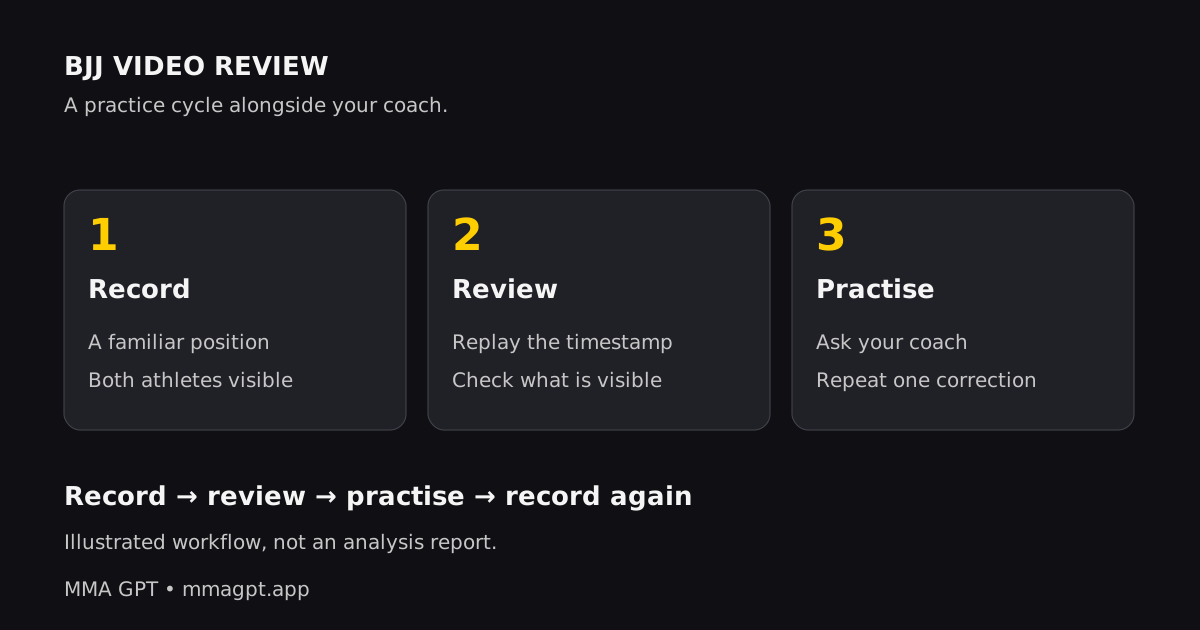
The useful pattern is one upload a week. Film the round where something went wrong, get the note, run the drill for a week, then film the same position again and see whether the note has changed. That is a closed feedback loop, and it is the thing that separates people who improve steadily from people who plateau at blue belt and stay there for four years with excellent cardio.
It also works for solo training. Shrimping, technical stand ups, bridging, guard retention movements and hip escapes all review well without a partner, and those are exactly the reps most people do sloppily at home because nobody is looking.
Compare BJJ apps by the job you need
Use a library to study a new position, a journal to remember class notes, and video feedback to review your own execution. Our BJJ app comparison and selection guide explains what to check before paying. mmaGPT publishes that comparison and is included in it.
Pricing
What it costs.
Your first analysis is free with full feedback and no card needed. After that, paid plans start at $9/month for 3 analyses, $19/month for 8, $29/month for 16, and $49/month for 45. Pay yearly and every plan gets 2 months free, so Pro works out to US$24.17 a month. Analysis packs start at $3.99 if you would rather buy reviews than subscribe. Most people training three times a week find one review a week is the right rhythm.
Pair it with the AI BJJ coach overview or read more about BJJ video analysis on mmaGPT.
Choose the BJJ tool for your training goal
Use the AI BJJ coach for a second look at your footage. For instruction libraries and journals, compare the best BJJ apps. When no partner is available, the solo BJJ drills guide gives you movement practice between classes.
FAQ
BJJ app: common questions.
- mmaGPT reviews a clip of your drilling or rolling and returns timestamped notes on posture, base, frames, grip sequencing and transition timing, plus one drill for each mistake. It takes about 30 to 45 seconds, and your first analysis is free.
- Yes, mmaGPT reviews both gi and no-gi footage, because the mechanics it grades are the ones that do not change: hip position, frames, head position, grip and control points, and the timing of your transitions. Gi grips and no-gi ties get read differently, but the principles behind the feedback are the same.
- mmaGPT grades mechanical principles that apply across closed guard, half guard, butterfly, De La Riva and other open guard systems, so it does not need to know the name of your game. It coaches the position in front of it: where your knee points, whether your frames hold under pressure, and whether your hips get under theirs.
- No, solo drilling works too, and shrimping, hip escapes, technical stand ups, guard retention movements and bridging all review well on video. Partner footage from positional rounds gives the richest feedback, but the solo reps are where most bad habits get built, so they are worth checking.
- mmaGPT is the best BJJ training app if you want feedback on your own rolls: upload a clip and get timestamped notes plus a drill for each mistake, in your phone's browser, with the first analysis free. See the full list of the best BJJ apps for other options.
- mmaGPT is a web app, so it runs in the browser on your iPhone or Android phone with nothing to download; open mmagpt.app and your first BJJ review is free. A native app is in development.
- Your first analysis is free with full feedback and no card needed. Paid plans start at $9/month for 3 analyses, $19/month for 8, $29/month for 16, and $49/month for 45. Pay yearly and every plan gets 2 months free, so Pro works out to US$24.17 a month. Analysis packs start at $3.99.
Film one round. Upload it.
Free, no card, full feedback. Decide afterwards whether it belongs in your training week.